Ponca Tribe Marker
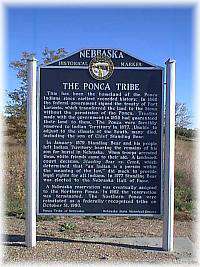
This has been the homeland of the Ponca Indians since earliest recorded history. In 1866, the Federal government signed the treaty of Fort Laramie, which transferred the land to the Sioux without the permission of the Ponca. Treaties made with the government in 1856 had guaranteed their land to them. The Ponca were forcibly removed to Indian Territory in 1877. Unable to adjust to the climate of the South, many died, including the son of Chief Standing Bear.
In January 1879, Standing Bear and his people left Indian Territory bearing the remains of his son for burial in Nebraska. When troops arrested them, white friends came to their aid. A landmark court decision, Standing Bear vs. Crook, which determined that " an Indian is a person within the meaning of the law," did much to provide legal rights for all Indians. In 1977, Standing Bear was elected to the Nebraska Hall of Fame.
A Nebraska Reservation was eventually assigned to the Northern Ponca. In 1962, the reservation was terminated. The Northern Ponca were reinstated as a federally-recognized tribe on October 31, 1990.
– Nebraska State Historical Marker
Getting There & Details
- Map
- Get Directions →
More Things to Do
Chief Standing Bear Memorial Bridge
The "Chief Standing Bear Memorial Bridge" over the Missouri River is approximately 3000 feet long…
Learn more →Church of Our Most Merciful Savior
Built in 1884, this one story church with board and batten siding is the only…
Learn more →Chief Standing Bear
Ponca Chief Standing Bear merely wanted to fulfill a promise; instead, he became part of…
Learn more →Chief Standing Bear
Ponca Chief Standing Bear merely wanted to fulfill a promise; instead, he became part of…
Learn more →