Hudson-Meng Bison Kill
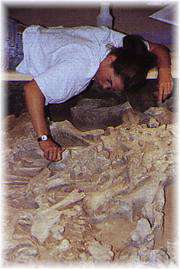
When Albert Meng was preparing to build a pond in the early 1950s, he uncovered bones weathering out of an eroding bank, and could not have imagined how important his discovery would become. A local rancher interested in archaeology, Albert, and his friend Bill Hudson, sought professional advice to see if the bones were important to science.
Finally succeeding after several years, the two men lent their names to what today is the largest bison bonebed (estimated to be about the size of a football field) of its age (nearly 10,000 years old) in the Western Hemisphere. The Hudson-Meng Bison Kill is an outstanding example of how ordinary people can make extraordinary contributions to understanding our past.
The story of the bonebed is mysterious and exciting. Scientists identified an extinct species of bison (Bison antiquus) during the first excavations in the 1970s. Stone artifacts found near the bones were identified with the Alberta culture that existed 8,000 to 10,000 years ago. These plains hunters relied heavily upon bison for their survival as did later inhabitants. Archaeologists theorized that the bone layer resulted from a bison jump, with as many as 1,000 bison being stampeded over a nearby cliff, killed with spears, dismembered, and then moved several meters from the drop area for systematic butchering.
Current excavations at the Hudson-Meng Bison Kill began in 1991 in cooperation with archaeologists from Colorado State University and the University of Wyoming. These researchers proposed a different interpretation: The bonebed resulted from a natural death event, not a bison jump. If humans were not responsible for the demise of the bison at this bonebed, then what caused them to die? It’s still a mystery that intrigues both visitors and scientists from around the world.
A visit to the Hudson-Meng Bison Kill is a visit to a modern archaeologic excavation in progress. Interpretive displays and guided tours help you understand why this is such an important discovery, and encourage you to develop your own theories about wshat happened to the bison. The site is located in Nebraska’s Oglala National Grassland, on the shoulder of the picturesque Pine Ridge, overlooking the Black Hills of South Dakota. And it’s only a few miles to the moonscape of Toadstool Geologic Park.
Getting There & Details
- Admission
- FEES: Plus tax: Adult: $4.00; Seniors 60+, $3.50; Children 5-12, $2.00, Children 5 and under, FreeGroup rates and tours are available
- Hours
- HOURS: Open daily, Memorial Day through Labor Day, 9:00 a.m. to 5:00 p.m.
- Address
- Northeast of Harrison - Access from Crawford following Highway 2 north for 4.2 miles to Toadstool Road. Follow Toadstool Road for 7.4 miles to the int
- Phone
- 605-745-6017
- [email protected]
- Website
- www.hudson-meng.org
- Map
- Get Directions →
Call 308-432-0300 for information during the off season.From Crawford following Highway 2 north for 4.2 miles to Toadstool Road. Follow Toadstool Road for 7.4 miles to the intersection of Sand Creek Road, 6.3 miles on Sand Creek Road to the turnoff.
More Things to Do
Historical Monuments
Fort Laramie to Fort Robinson Trail - After the 1868 Treaty of Fort Laramie guarnateed…
Learn more →Recreation
Swimming and Tennis - The town of Harrison offers several types of recreational facilities in…
Learn more →Agate Fossil Beds National Monument
Located on the Niobrara River in northwestern Nebraska, the Agate Fossil Beds and its surrounding…
Learn more →Oglala National Grassland
One of only 20 national grasslands managed by the USDA Forest Service, the Oglala National…
Learn more →