Swedish Crosses Cemetery
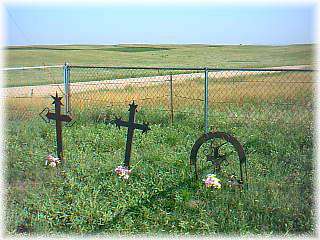
For over a century, three unique crosses have been a lasting symbol of the Swedish heritage of Gothenburg.
In the early 1880s, Peter and Anna Berg, along with Anna’s parents, the Benjamin Palms, came to Gothenburg from Helsingland, Sweden. Tragedy struck the Bergs on their prairie homestead when their first child, Singne Ester, died July 21, 1885, four months after her birth.
Carl Alfred, their second child, died at the age of three months on September 14, 1886. Gustav Andrew, two years old, died August 19, 1889. The three children were buried on a knoll near the family farm.
Markers for the graves were made in a traditional Swedish style by the children’s grandfather, Benjamin A. Palm. Mr. Palm was Gothenburg’s first blacksmith.
He is reported to have sent to Sweden for some of the steel with which he fashioned the crosses. The distinctive crosses, complete with elaborate scrollwork, hearts and stars, each carry a Swedish inscription of the children’s names and their dates of birth and death. The Bergs were blessed with four more children after the first three died.
A wrought iron fence forged by Mr. Palm to protect the graves has long since disappeared. The late Harry Williams of Gothenburg began an effort to preserve the cemetery in the 1960s. With the aid of an anonymous donor and the Historical Trails Committee, a chain link fence was erected in 1967.
Although the crosses have stood for over 100 years, several mysteries remain. The initials A.G. on one of the graves stands for Andrew Gustav, but the family remembers he was called Gustav. What was the order of his formal name? On the back of Singne’s cross, the word Havilar is etched. Many tombstones and crosses in Sweden have this inscription. It translates to “Here Rests”. However, the other two crosses have the initials H.W. Do the initials mean the same? The causes of their deaths have never been conclusive. Family stories tell of an epidemic that struck in the late 1800s. It is also believed several neighboring children caught in a prairie fire are buried here without markers.
These unusual and artistic grave markers, wrought in Swedish steel by a loving grandfather, mark three children’s graves–making a small corner of Dawson County “forever Sweden.”
The Swedish Crosses Cemetery is one of Dawson County’s historical sites. A Nebraska Historical Marker was dedicated in August, 1991.
Getting There & Details
- Address
- 2 mi. N. of Gothenburg on NE Hwy 47 and 2 mi. W. on Road 769.
- Phone
- 308-537-3505
- Map
- Get Directions →
More Things to Do
1320 Lake Avenue
James E. Norsworthy came to Gothenburg with his wife Sarah in 1889. In 1905 he…
Learn more →3rd annual relay for life car and bike show
show june 29th .ehmen park. 15th and hwy 47. food-vendors-kids games.dash plaques 1st 125.plenty of…
Learn more →City Parks
Gothenburg has four parks covering 55 acres. Facilities include swings, picnic areas, pool, athletic fields,…
Learn more →Ernest A. Calling House
Ernest A. Calling, a pioneer businessman of Gothenburg, hired L.J. Anderson to build this distinctive…
Learn more →